
A student gets an assignment due tomorrow: rewrite a short paragraph in Shakespearean English for drama class. She pastes the same three sentences into three different online translators. One spits back “thee” everywhere a modern speaker would say “you.” Another adds “-eth” to the end of every single verb, including ones that already end in “-eth.” The third gives her something that reads like a fortune cookie wrote a Renaissance fair pamphlet. She has no idea which one, if any, her teacher will actually accept, and no way to check.
That’s the real problem most people run into. It’s not that Shakespearean English is hard to fake, it’s that it’s easy to fake badly, and most tools don’t tell you the difference.
Quick answer: A Shakespearean English translator swaps modern words and pronouns for their Early Modern English equivalents, turning “you” into “thou” or “thee” depending on grammar, and “your” into “thy” or “thine” depending on the next word. It works through rule-based word substitution with smart heuristics, not true historical translation, so it’s a fast way to get period-flavored text, but the grammar still needs a quick gut check before you use it somewhere that matters.
What Counts as “Shakespearean English”?
Here’s the confusion at the root of almost every bad translation: “Shakespearean English” and “ye olde English” are not the same thing, even though most costume shop signage and half the generators online treat them as interchangeable.
Real Shakespearean English is a form of Early Modern English, the language spoken and written in England roughly between 1500 and 1650. It’s the language of the King James Bible, of Shakespeare’s plays and sonnets, and of ordinary letters and court documents from that period. It has actual grammar rules: a second-person pronoun system with “thou,” “thee,” “thy,” and “thine” that changes based on the pronoun’s role in the sentence, verb endings like “-est” for second person and “-eth” for third person, and vocabulary that had genuinely different meanings or forms than it does today.
“Ye olde English,” by contrast, is a modern invention, mostly built by tacking “ye” onto random nouns and swapping “the” for “ye” wherever it fits. It didn’t come from Shakespeare’s time at all. The “ye” in “Ye Olde Shoppe” signs is actually a leftover from an old printing convention where the letter “thorn” (þ), which made a “th” sound, was replaced with a “y” because early printing presses didn’t have a thorn character. It was pronounced “the,” never “yee.” So an old English translator that just replaces “the” with “ye” isn’t giving you anything historically accurate, it’s giving you a sign-painter’s shortcut.
An elizabethan English translator worth trusting distinguishes between these two things: real grammar shifts (thee, thou, thy, -eth, -est) versus surface-level costume shop cliches (ye, olde, shoppe). The first is genuinely period. The second is decoration.
How a Shakespearean Translator Actually Works (and What It Can’t Do)
Every online tool that claims to translate to old English, including this one, works the same basic way underneath: it’s a word and phrase substitution engine, not a true translator.
Here’s what that means in practice. The tool scans your input text and looks for patterns it recognizes. “You” gets swapped for “thou” when the tool detects it acting as a subject (when the word immediately after “you” is a verb), and for “thee” when it appears in an object position. “Your” becomes “thine” when the next word starts with a vowel sound, and “thy” otherwise. Certain common verbs get their period-appropriate forms, “is” gets swapped for “art,” “do” for “dost,” and “does” for “doth,” as flat word replacements. Common modern idioms and greetings get swapped for period equivalents where a direct match exists, “hello” becomes “hail,” “goodbye” becomes “fare thee well.”
What it’s not doing is restructuring your sentence the way a real Elizabethan writer would have. It’s not adjusting word order, it’s not applying iambic pentameter, and it has no way to judge tone or context. The “you” to “thou/thee” heuristic is a smart guess based on the very next word, not a full grammatical parse of the sentence, so it can still get tripped up by complex clauses or unusual word order. If you type a modern legal disclaimer or a sarcastic tweet, the tool will dutifully swap the pronouns and verb endings without noticing that the result sounds absurd. It also can’t catch idioms with no clean historical equivalent, slang, brand names, or grammatical edge cases that depend on the full sentence rather than just the word in front of it.
That’s not a flaw unique to this tool, it’s the honest ceiling of what rule-based substitution can do. You can try the Shakespeare Translator yourself to see this in action: paste in a full sentence, and you’ll get a fast, mostly-correct first pass that’s genuinely useful for costumes, captions, and classroom exercises, but it’s still worth a quick read-through before you commit to it for something like a wedding program or a graded assignment.
Thee, Thou, Thy, and Thine: The Rule People Get Wrong Most
If there’s one grammar point that separates a convincing Shakespearean sentence from an obviously fake one, it’s this. Most people know that “thee” and “thou” mean “you,” but almost nobody knows they’re not interchangeable. Each one has a specific grammatical job, the same way modern English still distinguishes “I” from “me” even though both mean the speaker.
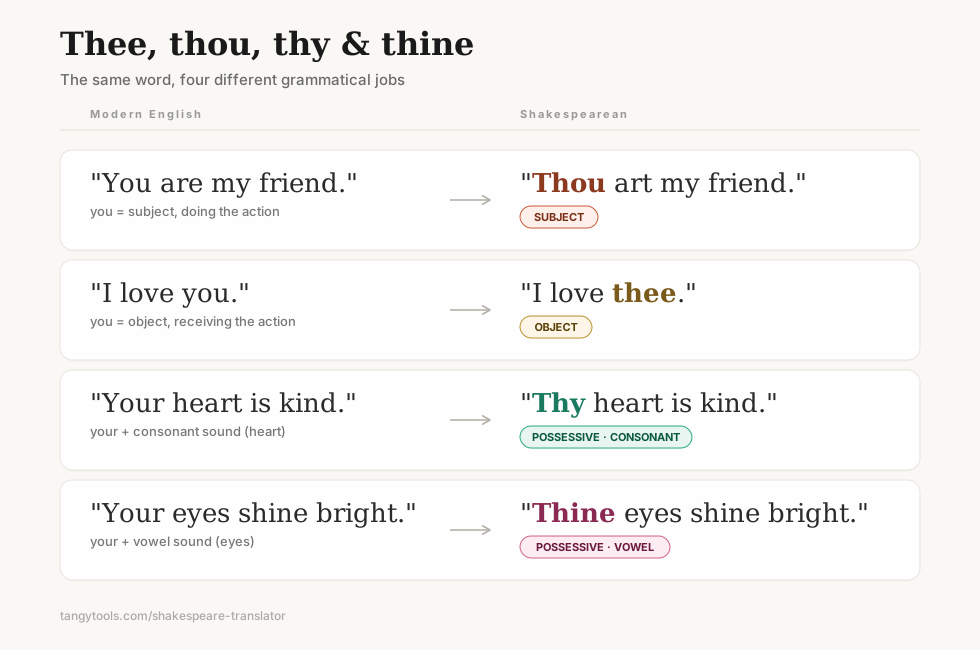
| Grammatical role | Word | Example sentence |
|---|---|---|
| Subject (the one doing the action) | Thou | ”Thou art my friend.” (you are my friend) |
| Object (the one receiving the action) | Thee | ”I love thee.” (I love you) |
| Possessive, before a consonant | Thy | ”Thy heart is kind.” (your heart is kind) |
| Possessive, before a vowel sound | Thine | ”Thine eyes shine bright.” (your eyes shine bright) |
The pattern to remember is the same one modern English still uses with “I” and “me.” You’d never say “Me am going to the store,” you’d say “I am going to the store,” because “I” is the subject form. “Thou” works the same way, it’s the subject form, so it goes where “you” would go if “you” were doing the action. “Thee” is the object form, so it goes where “you” would land if the action were happening to it.
The translator on this site uses a heuristic to guess which form to use: if the word immediately after “you” looks like a verb, it picks “thou” (subject). Otherwise it picks “thee” (object). For “your,” it checks whether the next word starts with a vowel and picks “thine” if it does, “thy” if it doesn’t. This works well on most straightforward sentences, but it’s a guess, not a guarantee. If your sentence has unusual word order or a complex clause, the heuristic might pick the wrong form, which is why the thee/thou table above is still worth checking.
Verbs have to agree with “thou” too, which is where a lot of fake Shakespearean text falls apart. “Thou art” is correct, “thou is” or “thou are” is not. “Canst thou help me?” is correct, “canst thou helpeth me?” is a common mistake, since a modal verb like “canst” is always followed by the base form of the next verb, not an “-eth” ending.
Common Words and Phrases, Modern to Shakespearean
Beyond the pronoun system, a handful of everyday words and greetings show up constantly in period writing and are worth knowing on sight. This isn’t an exhaustive dictionary, it’s the short list that covers most of what people actually search for when they ask how do you say a word in Shakespearean English.
| Modern | Shakespearean | Usage note |
|---|---|---|
| Hello | Hail / Well met | ”Hail” for a formal greeting, “well met” when meeting someone by chance |
| Goodbye | Fare thee well | Literally “may things go well for you” |
| Yes | Aye | Still used today in formal votes and by sailors |
| No | Nay | Pairs naturally with “aye” |
| You are | Thou art | Second-person singular subject form |
| Are not | Art not | Used after “thou” in a question or negation, e.g. “Thou art not ready” |
| My friend | Good friend / Fair friend | ”Fair” implies warmth, not just physical appearance |
| I don’t know | I know not | Negation moves after the verb, not before it |
| Very | Passing / Right | ”Passing fair” means “very beautiful” |
| Listen | Hark / Attend | ”Hark” for a sudden call to attention |
| Look | Behold / Lo | ”Lo” is an exclamation, “behold” is a command |
| Soon | Anon / Presently | ”Anon” means “soon,” not “right this second,” a common mistranslation |
| Sir/Madam | Good sir / Good lady | Standard polite address |
| Servant | Knave (informal/insulting) or Squire | Context changes the tone completely |
| Perhaps | Mayhap / Perchance | Both still recognizable to modern ears |
| Fool | Knave / Fool / Jester | ”Fool” was also a formal court title, not always an insult |
| Enough | Enow | Archaic plural form, mostly used with countable nouns |
A word like “anon” is a good example of why a quick gut check matters even after translating. It means “soon” or “shortly,” not “immediately,” so “I shall return anon” is right, but using it to mean “right now” is a small, telling mistake that gives away the fake.
How to Use the Shakespeare Translator on Tangy Tools
Getting a translation out of the tool takes seconds, but knowing what to do with the result matters more.
- Paste or type your text into the input box. A full sentence or short paragraph works better than single words, since the tool needs context to pick the right form of “thou” or “thee.”
- Read the output as it appears. The translation updates instantly as you type, so you can adjust your original wording on the fly if something looks off.
- Copy the result using the copy button, then paste it wherever you need it, an invitation, a script, a caption, or an assignment.
- Spot-check proper nouns and numbers. The tool leaves names, brand terms, numbers, and slang untouched rather than guessing at a translation, since forcing a fake period equivalent onto something like “Netflix” or “WiFi” would look worse than just leaving it alone.
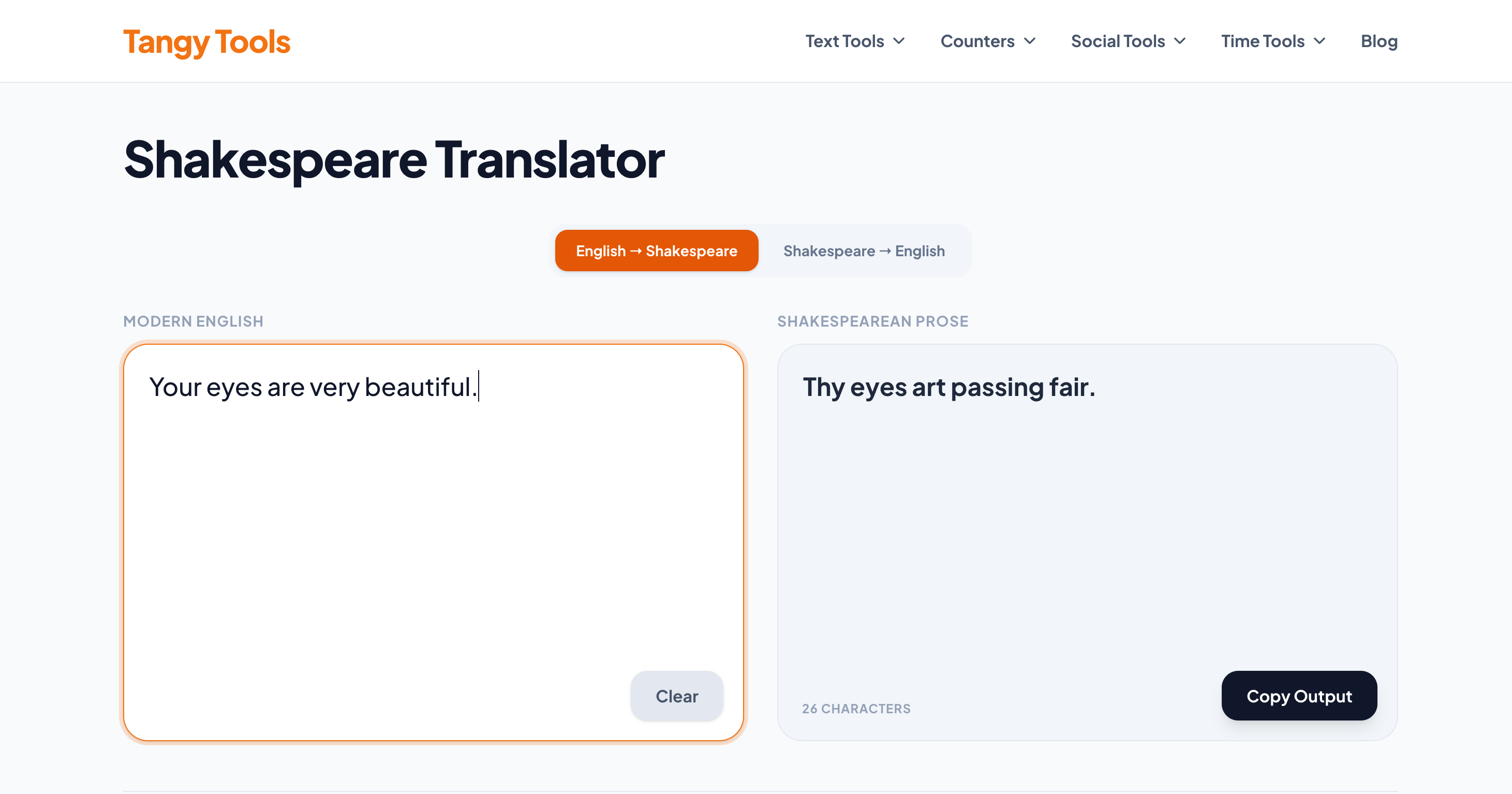
That edge case in step 4 is worth understanding, because it trips people up. If you type “Call me on my iPhone at 5pm,” the tool will translate the pronouns and common words around it but leave “iPhone” and “5pm” exactly as they are. That’s intentional. Guessing a fake period word for a modern brand name or a specific number would introduce an error, not remove one, so the tool plays it safe and leaves anything it doesn’t recognize untouched. If you want your own text to feel period-consistent all the way through, that’s the part you’ll need to adjust by hand.
Ready to see it for yourself? You can convert your own text right now with whatever you’re working on.
Where People Actually Use Shakespearean Text
The way you should use a Shakespearean translator depends heavily on what you’re using it for. What counts as “good enough” for a Renaissance faire is different from what counts as good enough for a graded assignment.
Renaissance faire and cosplay scripts. Here, tone matters more than textbook accuracy. A believable faire character leans on rhythm and a handful of recognizable words (“hark,” “prithee,” “good sir”) more than strict grammatical correctness, since you’re performing a character, not submitting a linguistics paper. Overdoing the “-eth” endings actually reads as more convincing here than it would in writing.
D&D and tabletop bard dialogue. Similar to faire scripts, but usually shorter and punchier, since it needs to work read aloud at the table in real time. A well-placed “well met, traveler” lands better than a long, grammatically dense paragraph nobody can follow mid-session.
Wedding invitations and vows. This is where accuracy actually counts, since a typo or grammar slip on a printed invitation is permanent and visible to every guest. Run the translated text past the thee/thou/thy table above before it goes to print, and check your invite fits the card once you’ve settled on final wording, since Shakespearean phrasing tends to run longer than the modern sentence you started with.
Classroom exercises. Teachers using this as a demonstration tool benefit from showing students the translated output alongside the plain modern sentence, so the grammar pattern (not just the vocabulary swap) is visible. This is also where the difference between real Early Modern English and “ye olde” pastiche is worth explaining directly, since it’s a genuinely teachable moment about language history.
Social captions and jokes. Speed and humor matter more than precision. A quick, punchy line works better than a technically perfect one, and you can stylize it further for your caption afterward if you want the whole post to have a consistent visual look.
Common Mistakes That Break the Illusion
Even with a translator doing the heavy lifting, a few recurring errors show up often enough to call out directly, since spotting them takes the output from “close” to “actually convincing.”
Using “thee” where “thou” belongs. “Thee art wrong” should be “Thou art wrong.” Remember the I/me pattern: “thou” is the subject, “thee” is the object. The translator’s heuristic catches most of these, but unusual sentence structures can still slip through.
Adding “-eth” to every verb, including second-person ones. “-eth” belongs to third-person subjects (he, she, it, or a singular noun), not to “thou.” “Thou runneth” is wrong, it should be “thou runnest,” since second person takes “-est,” not “-eth.”
Mixing modern contractions with archaic pronouns. “Thou can’t” mixes a period pronoun with a distinctly modern contraction. Early Modern English simply didn’t contract this way, so it reads as an obvious patch job. “Thou canst not” is the period-consistent version.
Misusing “whither” for a static location. “Whither lieth the privy?” is a common mistake. “Whither” specifically means “to where,” implying motion toward a place, so it only fits a question like “Whither goest thou?” (where are you going). For a question about where something simply is, the correct word is just “where”: “Where lieth the privy?”
Using “doth” in the first person. “I doth love thee” is wrong. “Doth” is strictly a third-person form (“he doth,” “she doth”). First person uses “do”: “I do love thee” is the correct emphatic form.
Frequently Asked Questions
Q1. Is Shakespearean English the same as Old English?
A1. No. Old English refers to the language spoken in England before around 1150, and it looks nothing like Shakespeare’s writing. It is closer to a different language entirely. Shakespeare wrote in Early Modern English, from roughly 1500 to 1650, which is recognizably close to the English spoken today.
Q2. How do you say “you” in Shakespearean English?
A2. It depends on the word’s role in the sentence. “Thou” is used when “you” is the subject (“thou art”), and “thee” is used when “you” is the object (“I see thee”). The translator uses a heuristic to guess which form fits: if the word immediately after “you” looks like a verb, it picks “thou” (subject); otherwise it picks “thee” (object). But there is no single one-to-one swap, and unusual sentence structures can still trip it up.
Q3. What does “thee” and “thou” mean?
A3. Both mean “you,” but they are grammatically different forms of the same second-person singular pronoun. “Thou” is the subject form and “thee” is the object form, the same relationship “I” and “me” have in modern English.
Q4. Can I use a Shakespeare translator for a school assignment?
A4. It is a solid starting point for drafting, since it handles the pronoun and verb-ending patterns quickly, but check the specific grammar rules in this guide before submitting, especially the thee/thou/thy distinction. A teacher familiar with the material will notice a wrong “thee” or a misplaced “-eth.” The translator’s heuristic catches most straightforward cases, but edge cases with unusual word order may still need a manual check.
Q5. Is there a difference between Shakespearean English and Elizabethan English?
A5. Not really, they largely overlap. “Elizabethan English” technically refers to the language during Queen Elizabeth I’s reign (1558 to 1603), which covers most of Shakespeare’s writing career, so the two terms are usually used interchangeably in casual conversation.
Q6. Why does my translated text still look weird or wrong?
A6. Usually one of two reasons: either a proper noun, number, or slang term got left untranslated on purpose (the tool will not guess at those), or the original sentence had a grammatical structure the substitution rules do not fully cover, like a complex idiom with no direct period equivalent. The “you” to “thou/thee” heuristic is a smart guess based on the very next word, not a full parser, so edge cases with unusual word order may still need a manual read-through.
Q7. Do Shakespearean translators account for grammar, or just swap words?
A7. Mostly word and pronoun substitution based on grammatical role, with a heuristic that guesses subject vs. object for “you” and vowel vs. consonant for “your.” Common verbs like “is,” “do,” and “does” get swapped for their period forms as flat replacements, not through full conjugation tracking. It gets you close, especially on pronouns and common verbs, but it will not restructure sentence order or apply meter the way an actual Elizabethan writer would.
Q8. Is my text kept private when using this translator?
A8. Yes. The Shakespeare Translator runs entirely in your browser using JavaScript, so nothing you type is uploaded, stored, or sent anywhere. Closing or refreshing the page clears it completely.
Conclusion
A Shakespearean translator can get you most of the way there in seconds, swapping in the right pronouns, verb endings, and period vocabulary faster than looking any of it up by hand. But the last ten percent, knowing when “thee” should really be “thou,” or catching a stray “doth” in the wrong person, is what separates text that reads as genuinely period from text that just reads as trying too hard. The translator’s heuristic handles the obvious cases automatically, but run your next translation past the thee/thou/thy table above before you commit to it, and you’ll land a lot closer to convincing than most of what’s floating around online.
More guides in this series: