You’re in a Discord study server at 11pm, finishing a limits problem. You type “n” into a subscript generator, it hands back “ₙ,” and you paste it in: “as n approaches infinity, aₙ converges to L.” Perfect. Ten minutes later you need to label a different variable, so you type “c” into the same generator expecting the same result. Instead the output box just shows “c” back, unchanged, like nothing happened. Your study partner asks if you meant something else.
You didn’t do anything wrong, and neither did the tool. The letter c just doesn’t have a subscript form in Unicode, so the generator has nothing to convert it to. Rather than guessing at a substitute, it leaves the character exactly as you typed it. Neither do several other letters. This post covers exactly which math subscript notation works, which quietly fails, and what to do about it.
Quick Answer
Numbers always work as subscript (x₀ through x₉). Most single lowercase letters used in math work too, but not all of them. Here’s the fast reference for common math subscript symbols:
| Notation | Example | Unicode-safe? |
|---|---|---|
| Indexed variable | xₙ | Yes |
| Single digit index | x₁ | Yes |
| Log base 2 | log₂ | Yes |
| Log base e | logₑ | Technically yes, but use “ln” instead |
| Sequence term | aᵢ | Yes |
| Matrix element | aᵢⱼ | Partially, gets cramped fast |
For any of these, you can generate clean subscript characters instantly with our Subscript Text Generator, then paste the result anywhere plain text is accepted.
Where Math Actually Uses Subscript
Subscript shows up in math in a handful of recurring places, and knowing which bucket your notation falls into tells you what to expect from plain text.
Indexed variables are the most common case: xₙ, x₁, x₂, used any time you’re referring to a general or specific term in a list of related values.
Log and function bases come next: log₂ for binary logarithms, log₁₀ for common logarithms, both frequent in computer science and algebra problems.
Sequences and series use subscript to track position: aₙ for the nth term of a sequence, or Σaᵢ when summing a series across an index i.
Matrix and tensor indices use subscript pairs to point at a specific entry: aᵢⱼ for the entry in row i, column j.
Physics variables lean on subscript just as heavily, though for a slightly different reason than math does. Where algebra mostly uses subscript to label position in a list (x₁, x₂, x₃), physics uses it to label which quantity you’re talking about in a specific situation. v₀ means initial velocity, the speed something had before anything happened to it. Fₙₑₜ means net force, the combined result of every force acting on an object at once. tᵢ and t_f show up constantly for initial and final time in kinematics problems. The letters chosen aren’t random either, they’re usually abbreviations (net, initial, final) rather than index variables, which is part of why physics subscripts run into the Unicode letter gap more often than pure math does. “Net” needs an n, e, and t, all of which work, but plenty of other common physics abbreviations lean on unsupported letters the moment you go beyond single-letter shorthand. This overlaps a little with chemistry, but only for variables, not chemical formulas. If you’re formatting molecular formulas like H₂O or SO₄²⁻, our chemistry subscript guide covers that separately.
All of these cases share the same hidden assumption: that whatever letter or number you need will have a subscript form waiting for it in Unicode. That assumption holds up less often than people expect.
The Unicode Subscript Letter Gap (Why Some Math Won’t Render)
This is the part most people never learn until something breaks. Unicode subscript characters exist for digits 0 through 9, a small set of operators, and only some Latin letters: a, e, h, i, j, k, l, m, n, o, p, r, s, t, u, v, and x. There are also subscript versions of five Greek letters: beta, gamma, rho, phi, and chi.
The letters b, c, d, f, g, q, w, y, and z have no subscript Unicode character at all. This isn’t a font problem or an app limitation. You can check this yourself in Unicode’s own documentation: these letters were simply never added to the standard.
Here’s the full reference:
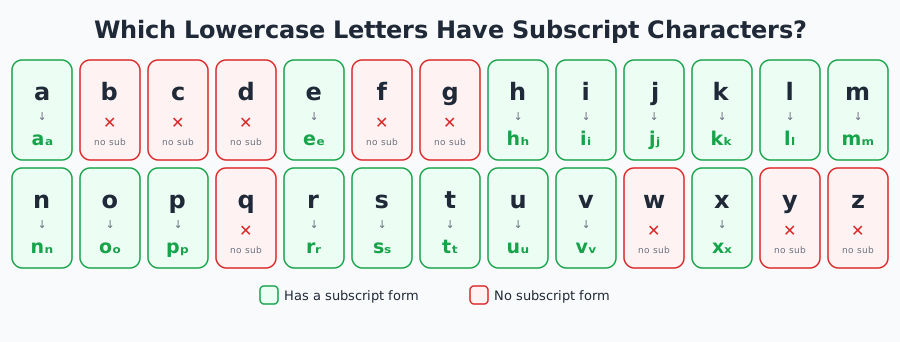
Why the gap exists is genuinely interesting and not random. These characters were added to Unicode bit by bit over the years to support things like phonetic spelling systems and language transcription, not math. Math users inherited whatever letters happened to survive that process. There was never a project to give every letter a subscript form for algebra or physics use. That’s why the set looks arbitrary: it wasn’t built for you, you’re just borrowing it.
Typing Indexed Variables Correctly (xₙ, x₁, x₂…x_k)
Numeric subscripts are always safe. x₀ through x₉ all have dedicated Unicode characters, so writing x₁, x₂, or x₃ for specific terms works everywhere plain text is supported.
Letter subscripts are safe only if the letter is in the supported set above. Drop the letter k into a subscript generator and you get ₖ back, so x_k turns into xₖ cleanly. Drop in the letter q instead, and the generator has nothing to give you, so it just hands back a plain q. If you’re writing by hand instead of using a generator, the same rule applies to the x_k shorthand people use as a placeholder: k converts to something real, q has nowhere to go. This is one of the most common places students get tripped up, because k and q feel like interchangeable placeholder letters in casual math writing, but only one of them can actually become subscript.
Generator input: k   →   Generator output: ₖ   (so x_k becomes xₖ)
Generator input: q   →   Generator output: q   (unchanged, no subscript form exists)
If you land on an unsupported letter, the easiest fix is usually to just pick a different one that says the same thing. Instead of aᵦ for a “base” term, most people write a₀ or a_init and let the words around it carry the meaning. Instead of x_c for a term you’d otherwise label with subscript c, spelling it out as “x sub c” in plain words reads perfectly fine in a chat message, and nobody’s confused by it. You lose a little visual polish, but you keep the meaning intact, which matters more in a Discord message than in a published paper.
The same letter-by-letter check applies the moment you move from single variables to something with a name attached to it, like a logarithm.
Log Bases and Function Subscripts (log₂, log₁₀, logₑ)
Log base subscripts are some of the most searched math subscript symbols, and thankfully both common cases work cleanly.
log₂(8) = 3, since 2 raised to the third power equals 8. In Unicode this reads as “log₂(8) = 3” with a clean subscript 2.
log₁₀(100) = 2, since 10 squared is 100. Both digits in the subscript render correctly since numeric subscript is fully supported.
One convention worth knowing: logₑ is technically renderable in Unicode since e is a supported subscript letter, but it’s redundant. Mathematicians already have a dedicated symbol for log base e, which is “ln.” Writing logₑ instead of ln is not wrong, but it signals you may not know the shorthand, so most people default to ln in practice.
For the general case, log base b, where b can be any number, you run into the letter gap directly since b has no subscript form. Type b into a subscript generator and you just get b back. In plain text, the common workaround is to write it out as “log base b” or fall back to LaTeX like below.
\log_2 8 = 3
\log_{10} 100 = 2
\log_b x
Sequences, Series, and Matrix Notation (aₙ, Σaᵢ, aᵢⱼ)
A typical sequence definition line looks like this in Unicode subscript:
a₁, a₂, a₃, …, aₙ
Every character here is a digit or the letter n, both fully supported, so this renders cleanly in any chat app, forum, or document.
Matrix notation is where things start to strain. A single matrix entry, “the entry in row i, column j,” is written aᵢⱼ. Both i and j are supported subscript letters individually, but stacking two subscript letters next to each other with no spacing control makes the result look cramped and, in some fonts, hard to read clearly at a glance. There’s no way to add a comma or space between the two subscript characters that looks natural, since Unicode subscript characters aren’t designed to combine.
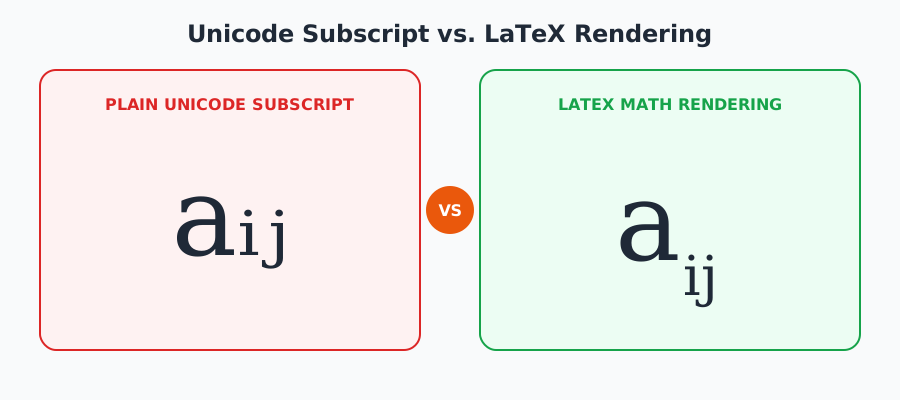
This is exactly the point where plain text subscript stops being the right tool, which the next section covers directly.
a_1, a_2, \ldots, a_n
a_{ij}
At this point the pattern should be clear: single letters and digits are safe, anything stacked or combined starts to strain. The next question is simply where that line should stop mattering to you.
When Unicode Subscript Is Enough vs When You Need LaTeX
Here’s a working rule instead of a vague “it depends.”
Use Unicode subscript when you’re writing in a chat app or platform that doesn’t render LaTeX, and your notation only needs a single letter or digit subscript. This covers Discord, WhatsApp, and iMessage for the vast majority of everyday math conversation.
Switch to LaTeX when you need double subscripts like aᵢⱼ, fractions, summation or integral bounds, a full matrix, or anything going into a formal document like a paper or lab report.
This is the exact fork the letter c ran into back in the intro. A single unsupported letter in a Discord message is a minor annoyance you can work around by rephrasing. But if that same variable needed to sit inside a formula with fractions, bounds, or a matrix next to it, rephrasing stops being enough and LaTeX becomes the only reliable option.
It helps to know where LaTeX actually renders inline, since it’s not universal. Some Discord servers use math bots that render LaTeX from typed commands. Notion and Obsidian (with the right plugin) render LaTeX blocks directly. Overleaf is built entirely around LaTeX. Some subreddits and forums run MathJax, which renders LaTeX syntax as proper math notation automatically. If you’re posting somewhere on this list, LaTeX is usually the better choice even for simple notation, since it will always render correctly regardless of which letter you need.
Common Mistakes Students Make
A few mistakes come up often enough with math subscript specifically that they’re worth naming directly.
-
Typing an underscore as a stand-in. Writing x_b by hand and expecting the reader to mentally convert it works fine for a human reading casually, but breaks for screen readers, which will read the underscore aloud, and for search engines, which won’t index it the same way as an actual subscript character. Running it through a generator afterward won’t fix this either, since a letter with no subscript form just comes back unchanged. The real fixes are picking a supported letter, spelling it out in words, or switching to LaTeX.
-
Mixing up subscript and superscript characters. Symbols that look similar at a glance, like ₂ and ², are an easy mistake that silently changes the meaning of what you wrote. x₂ and x² mean completely different things, one is an indexed variable and the other is squared.
-
Pasting subscript text into an automated math checker or online homework grader. This can backfire, since many of these tools parse plain text input looking for specific character patterns and don’t recognize Unicode subscript as the variable you intended, which can result in a correct answer being marked wrong.
-
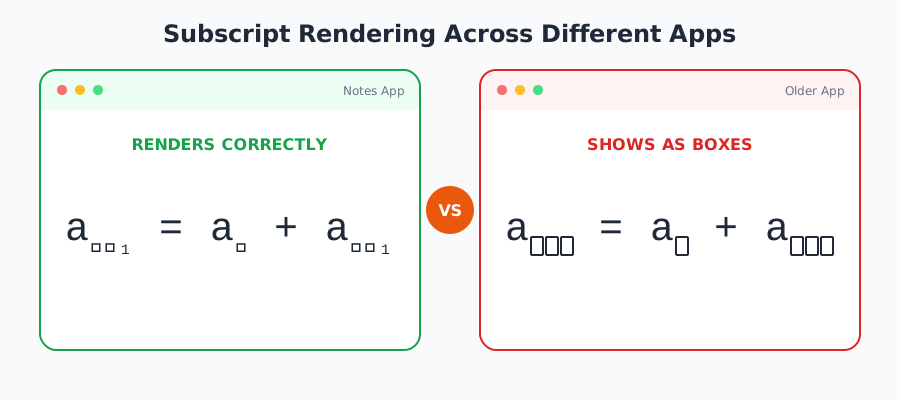
Assuming subscript looks the same everywhere. Some fonts, particularly older or less complete ones, don’t support the full subscript character range and will show empty boxes instead of the intended letter or number.
FAQ
Q1. How do I type xₙ with a subscript n?
A1. Type just the letter or number you want lowered, “n” by itself, into the Subscript Text Generator. Copy the ₙ it gives you back and place it right after the x. No underscore needed, the generator handles the conversion for you.
Q2. Why doesn’t subscript work for letters like b, c, or q?
A2. Those letters were never added to Unicode’s subscript character set. It isn’t an app or font bug, the characters genuinely don’t exist in the standard.
Q3. What’s the difference between log₂ and log_2 in plain text?
A3. log₂ uses an actual Unicode subscript character for the 2, while log_2 is just the digit 2 with an underscore typed in front of it by hand, with no true subscript formatting behind it. Both are readable to a person, but only log₂ displays as real subscript.
Q4. Can I use subscript for matrix notation like aᵢⱼ, or do I need LaTeX?
A4. You can technically generate aᵢⱼ in Unicode, but double subscripts get visually cramped fast since the two characters sit at the same height with no gap between them. For anything beyond a single matrix entry mentioned casually, LaTeX is the more reliable choice.
Q5. Should I use LaTeX or Unicode subscript for homework answers?
A5. If you’re typing in a chat app or a plain text field, Unicode subscript is faster and usually enough. If you’re submitting to a platform that renders LaTeX, or your notation involves double subscripts or fractions, use LaTeX instead.
Q6. What should I do if the letter I need has no subscript form?
A6. Pick a different letter that carries the same meaning, spell it out in words like “x sub c,” or switch to LaTeX if the platform supports it. Running the letter through a generator again won’t help, since it will just hand the same character back unchanged.
Q7. Why did my subscript text get marked wrong by an online math checker?
A7. Many automated checkers parse the exact characters you typed and don’t recognize Unicode subscript as equivalent to the variable it visually represents, so a correct-looking answer can still get flagged as incorrect.
Conclusion
Subscript for math notation works well for the cases Unicode actually supports, numbers, a limited set of letters, and simple sequence or log base formatting. The moment you need a letter outside that set, or you’re stacking two subscripts together, plain text stops being reliable and LaTeX becomes the better tool. For a complete look at subscript text across every use case, from social media formatting to chemistry notation, check out our complete guide to subscript text.